Black and White Art Piece With Torso With No Head by Japanese Artist
After more than than a century of luring tourists with their glorious blooms, the National Park Service is actively discouraging visits to see the famous cherry blossoms along Washington D.C.'due south Tidal Bowl, where access volition be limited or closed off completely because of the coronavirus pandemic.
There will be no parades or festivals, officials say. Access to cars and pedestrian walkways volition be limited, and the Tidal Basin could be closed altogether if crowds all the same grow across safe numbers. In that location volition be views available online with a streaming BloomCam. An "Art in Blossom" action involves 26 oversized ruby blossom statues painted past local artists effectually town and three can be institute at the Smithsonian'southward Haupt Garden, located behind the Castle Building along Independence Avenue. Some other "pandemic-appropriate" events are likewise scheduled.
"The health and condom of our Festival staff and the attendees, sponsors and other stakeholders remain the Festival's top priority," says Diana Mayhew, president of the National Red Blossom Festival.
As an alternative to hanami, the time-honored Japanese tradition of blossom viewing, it would exist natural to advise the blossoms found in the array of fine art at the Smithsonian'south National Museum of Asian Art. Merely the Freer Gallery of Art and Arthur M. Sackler Gallery, like the other Smithsonian museums, also continue to be closed out of a public-health caution associated with the coronavirus pandemic.
"We usually practice some kind of special serial of events inspired past the Ruddy Blossom Festival every year, because it is such an important part of D.C.'south identity, merely also as a way to bring Asia closer to the local audition, peculiarly Japan," says Frank Feltens, an banana curator of Japanese art at the museum. "This year because we cannot enter the museum and also, we are discouraged from congregating on the Mall and on the Tidal Basin to meet the blossoms, we created these various online offerings."
"Nosotros do take quite a number of works that depict cherry blossoms one manner or another," he says—some 200 out of the estimated 14,000 works from Japan lone. "Carmine blossoms are just such an important function of Nihon's visual culture to begin with." Indeed, visitors to Japan become a stamp on their passport with a stylized depiction of a cherry blossom bough.
Feltens and Kit Brooks, assistant curator of Japanese art, chose these 9 prime examples of cherry blossoms in Japanese artworks held in the museum'southward collections.
Washington Monument (Potomac Riverbank)
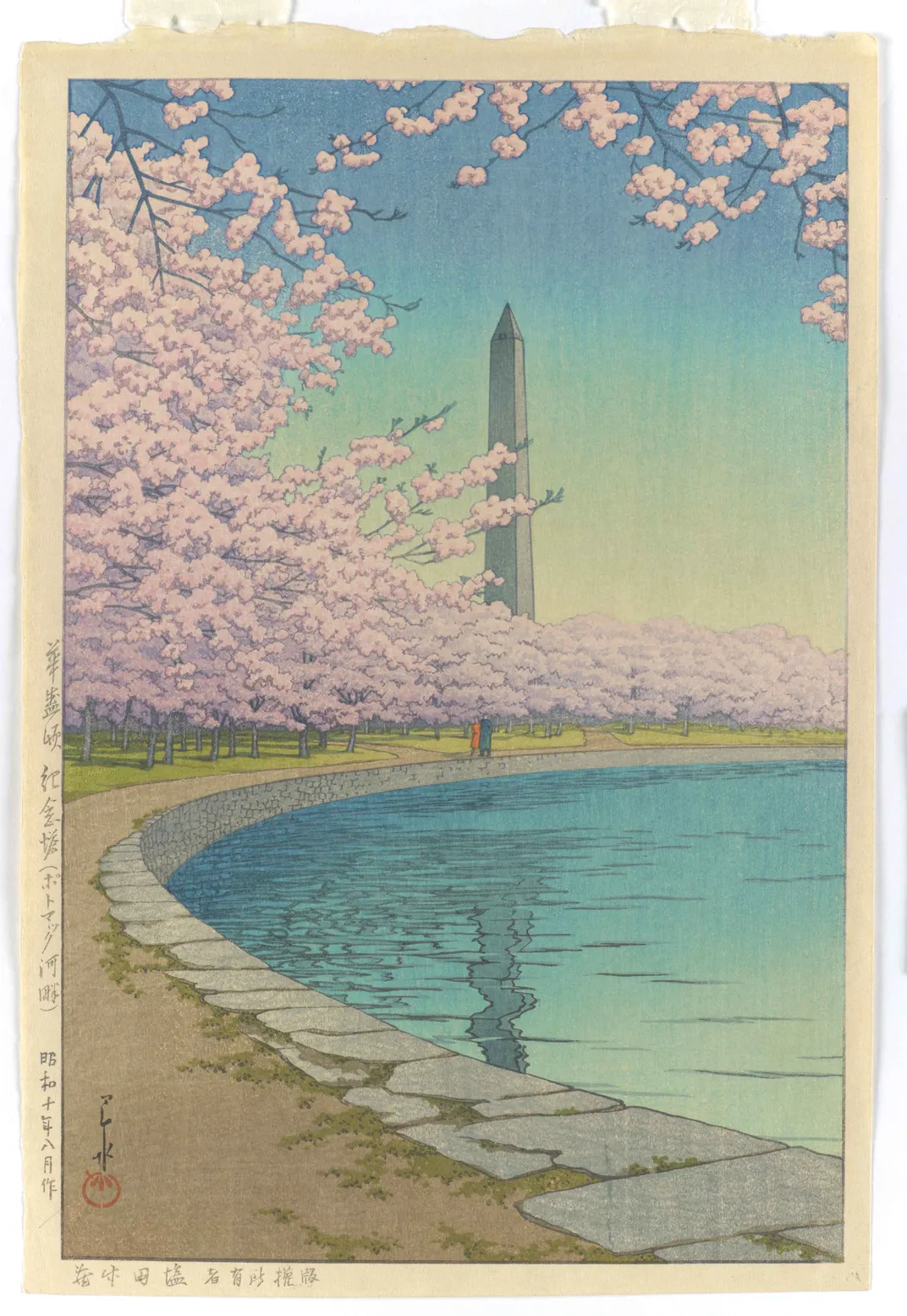
The woodblock print by Kawase Hasui (1883-1957), a prominent and prolific creative person of the shin-hanga (new prints) movement, depicts some of the more than three,000 Japanese cherry trees planted in West Potomac Park in 1912 by First Lady Helen Herron Taft and Viscountess Chinda, wife of the Japanese ambassador to the U.S. "That print was actually made in 1935 to commemorate the first Cherry-red Blossom Festival in D.C.," Brooks says. "It was deputed by a Japanese art dealer living in San Francisco." It was by a very popular creative person; Hasui was named a Living National Treasure in 1956, the year before he died.
Courtroom Ladies amidst ruby-red trees; Cherry blossoms, a high fence and retainers
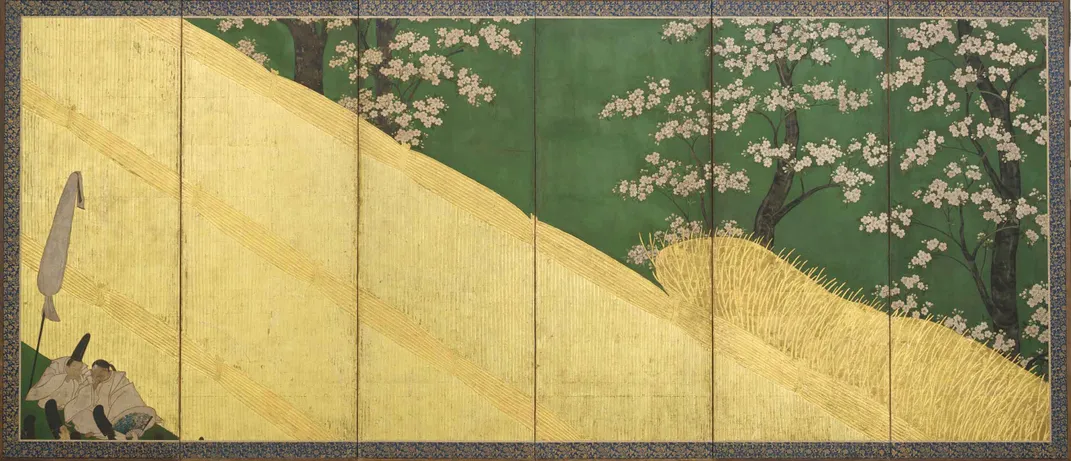
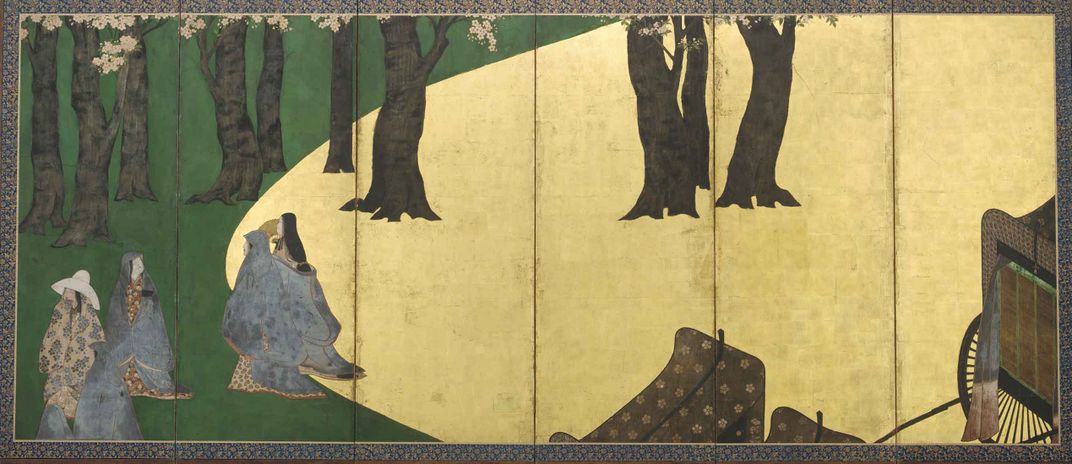
The pair of six-panel screens from the Edo flow depicts 2 scenes that have been connected to a archetype piece of work of Japanese literature from the early on 11th century, The Tale of Genji written past noblewoman and lady in waiting Murasaki Shikibu. But, Feltens says, the work instead reflects a decisive move abroad from literary specificity. "In that sense, it'south revolutionary in its own manner, using these big expanses of color, both the green and the golden are so incredibly prominent, to create these abstracted vistas, which is part of the appeal of Sōtatsu's style." At 5-foot-v-inches tall and nigh 25-feet across, the 2 screens would have immersed a viewer, Feltens says. "If you imagine that an average person in 17th-century Japan would probably be shorter than this screen, it would have been this towering vista of cherry blossoms."
Current of air-screen and cherry tree
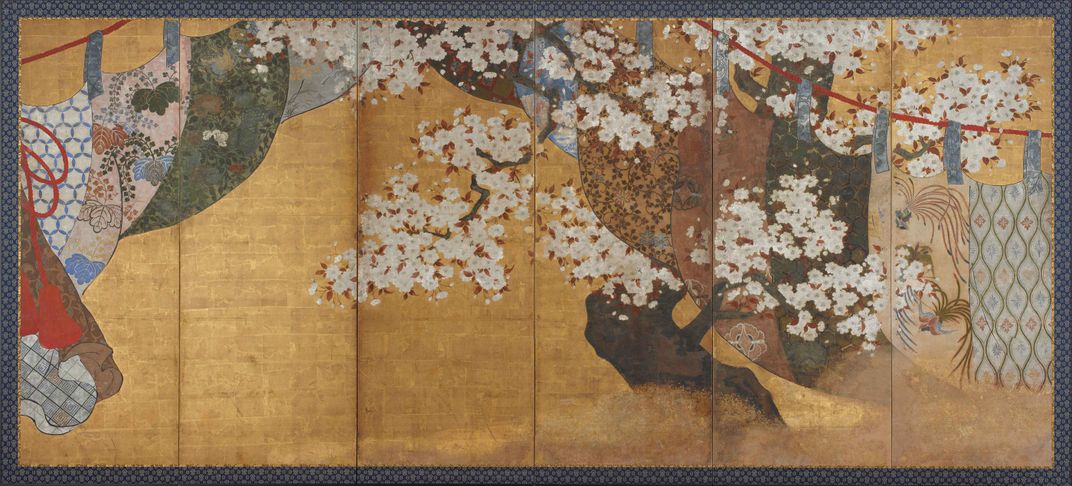
The painted six-panel screen, nearly 12-feet wide each, shows the white flowers of a ruby blossom amongst the equally delightful patterns of assorted wind screens, which seem to be actually flapping in the wind. "These brightly busy panels are hung with this red cord between the trees, every bit a temporary barrier," Brooks says. "And then if you were setting up a picnic, you could environment your group with these very decorative golden panels which would give you shelter from the wind as well equally a trivial variety, while creating this actually lively, beautiful backdrop, that tin motility with the wind, then it can motility with the elements. You lot're not existence totally separated from the environment that yous've chosen to spend your afternoon in."
Incense box
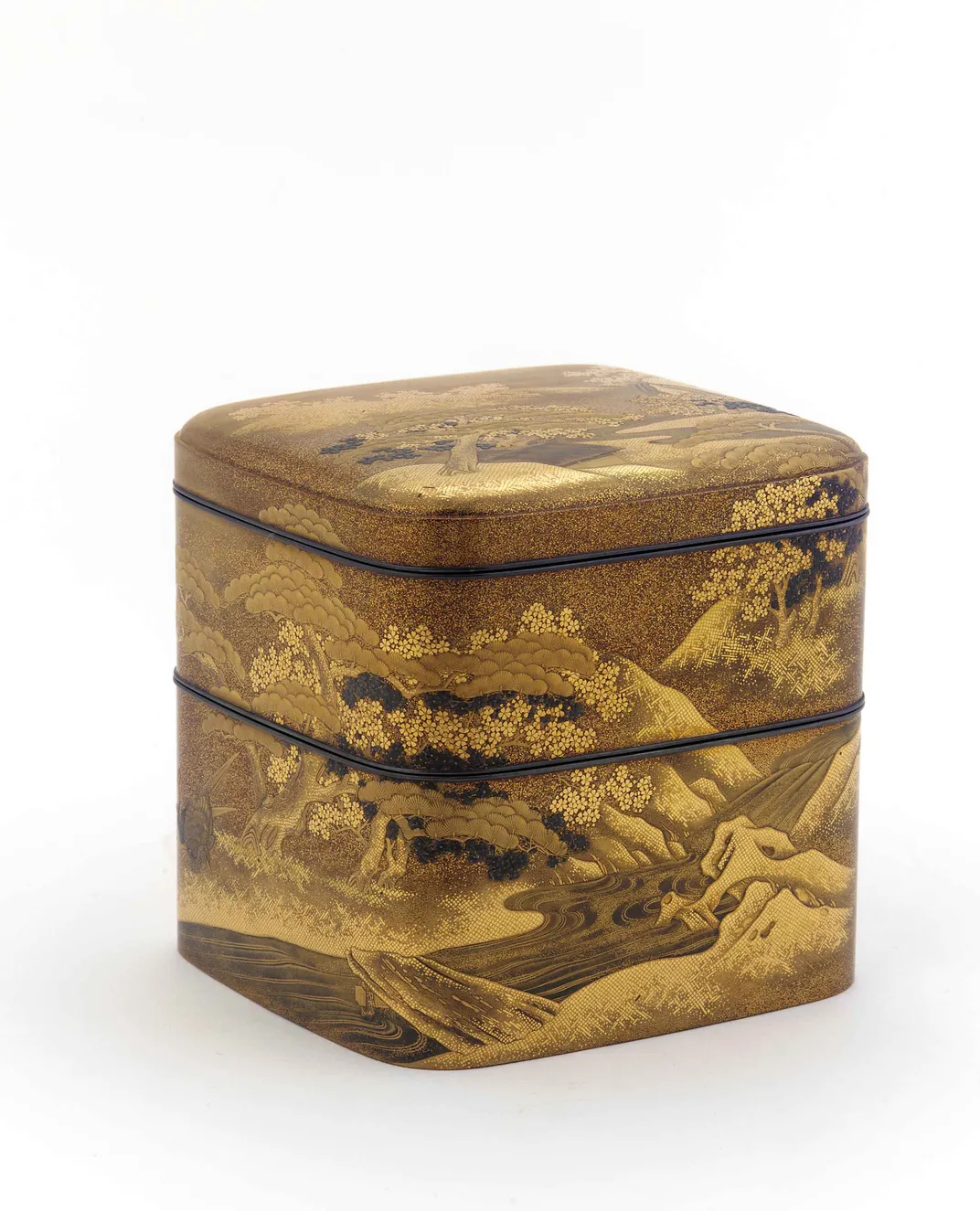
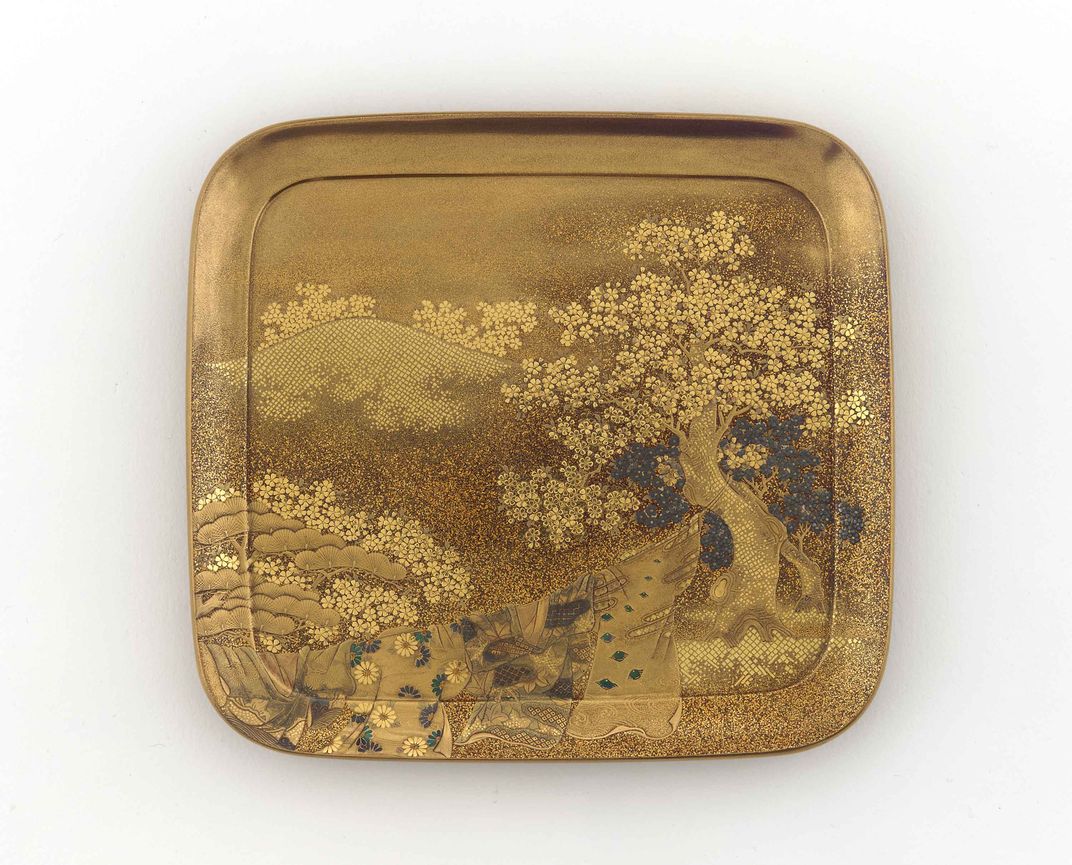
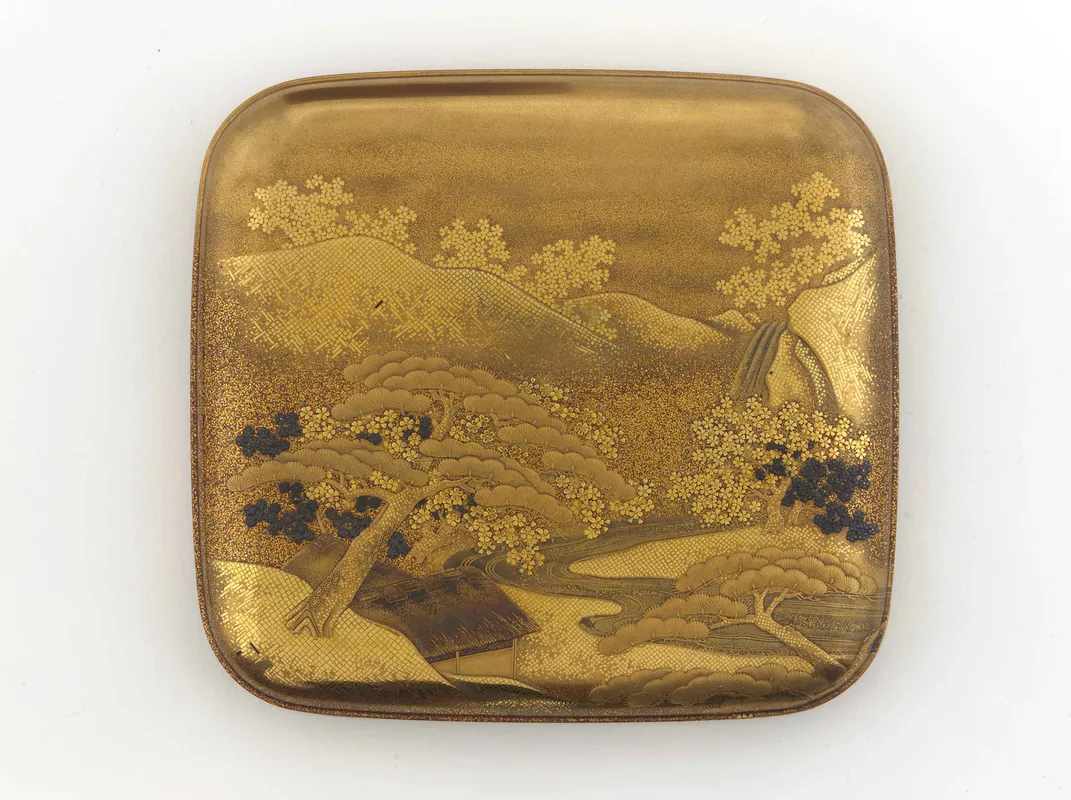
A 3-D work of art celebrating spring with scenes on each surface comes from the artist Kageyama Dōgyoku. The two-tiered lacquer incense container, slightly less than 5-inches-square, is rendered in gold and silver powder and leaf with a few pieces of inlaid iridescent shell. "This is a pretty late work from the 18th century, simply there has been a tradition in Japan of creating these gilded lacquer pieces for centuries before that," Feltens says. "This is in line with that tradition of adorning these utilitarian objects with the sumptuous decors." And while incense wouldn't exist burned in the lavish container—its basis is woods—it would odor sweetly from the incense that would be stored in it, he says.
A Picnic
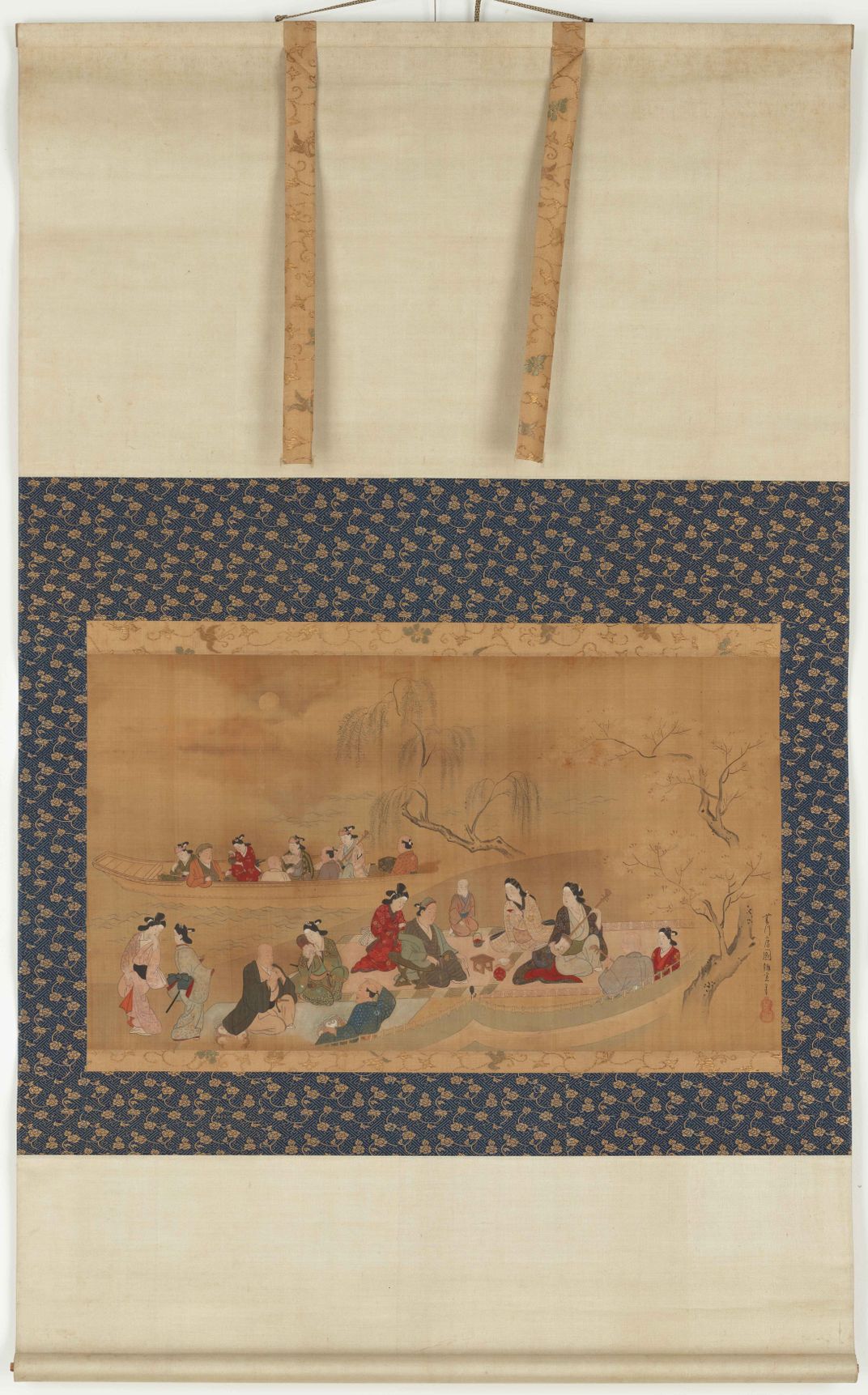
Hishikawa Moronobu (1618-1694) helped popularize the ukiyo-e woodblock prints and paintings, taking what he learned from his family unit's textile work to produce works like this silk hanging scroll. Moronobu was known for his distinct lines of the many figures in his piece of work—i has a flute; iii others play the traditional stringed instrument the shamisen. Twelve assemble on ane blanket while another viii arrive by boat. "These types of interior furnishings created natural vistas of what cherry trees could look like in the artistic fantasy," Feltens says. "They're similar to what they would wait similar in reality or nature, but idealized, for people to live with them and imagine them at times when the crimson blossoms weren't in blossom, so you could basically live with them whenever you wanted."
Spring Mural
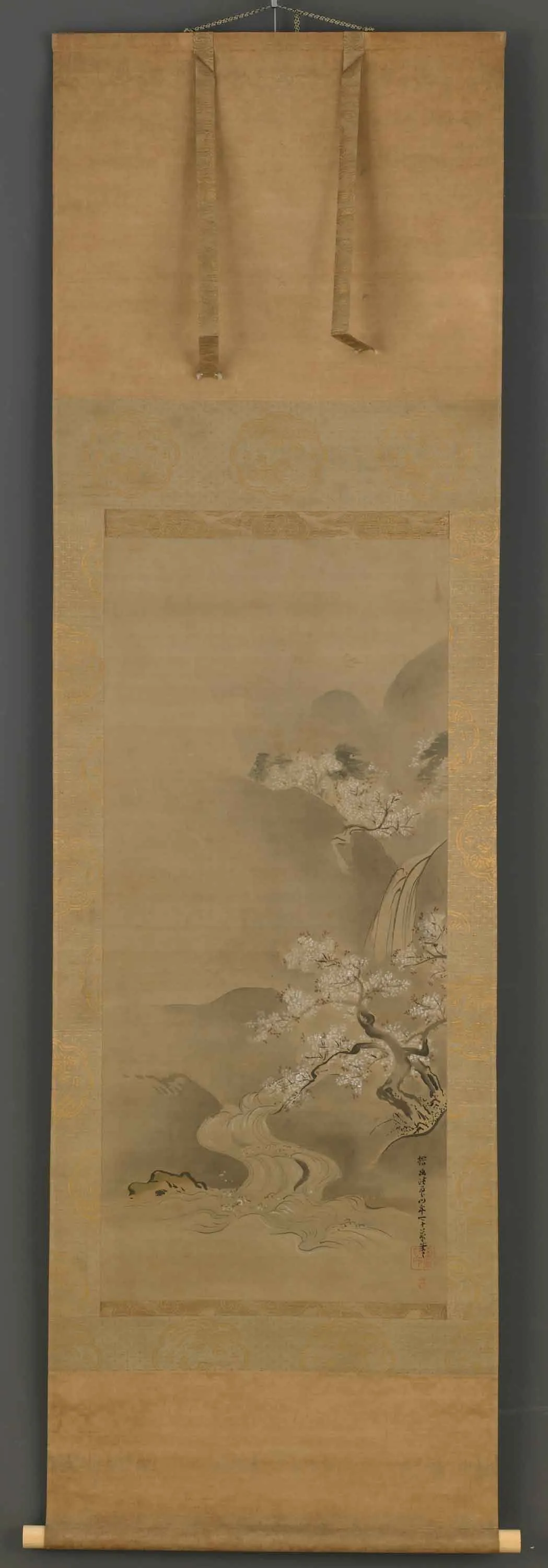
This hanging whorl from the Edo menses, nearly 7-anxiety-tall, not just has the rare signature of its artist, Kano Tan'yū (1602-1674), but as well his age, 71, and his Buddhist honorific title conferred on him a decade before. The rolling hills and blossoms depicted are thought to be the scenery of the mountains of Yoshino, a commune near Nara famous for its spring blossoms. "There is a long centuries-former tradition in Japan to immerse yourself into these interior settings that depict landscapes of any kind, and also to compose poetry in response to them," Feltens says. "That's not necessarily the example with the Edo menstruation screens we're looking at at present. But they come up from a similar tradition."
A Picnic Party
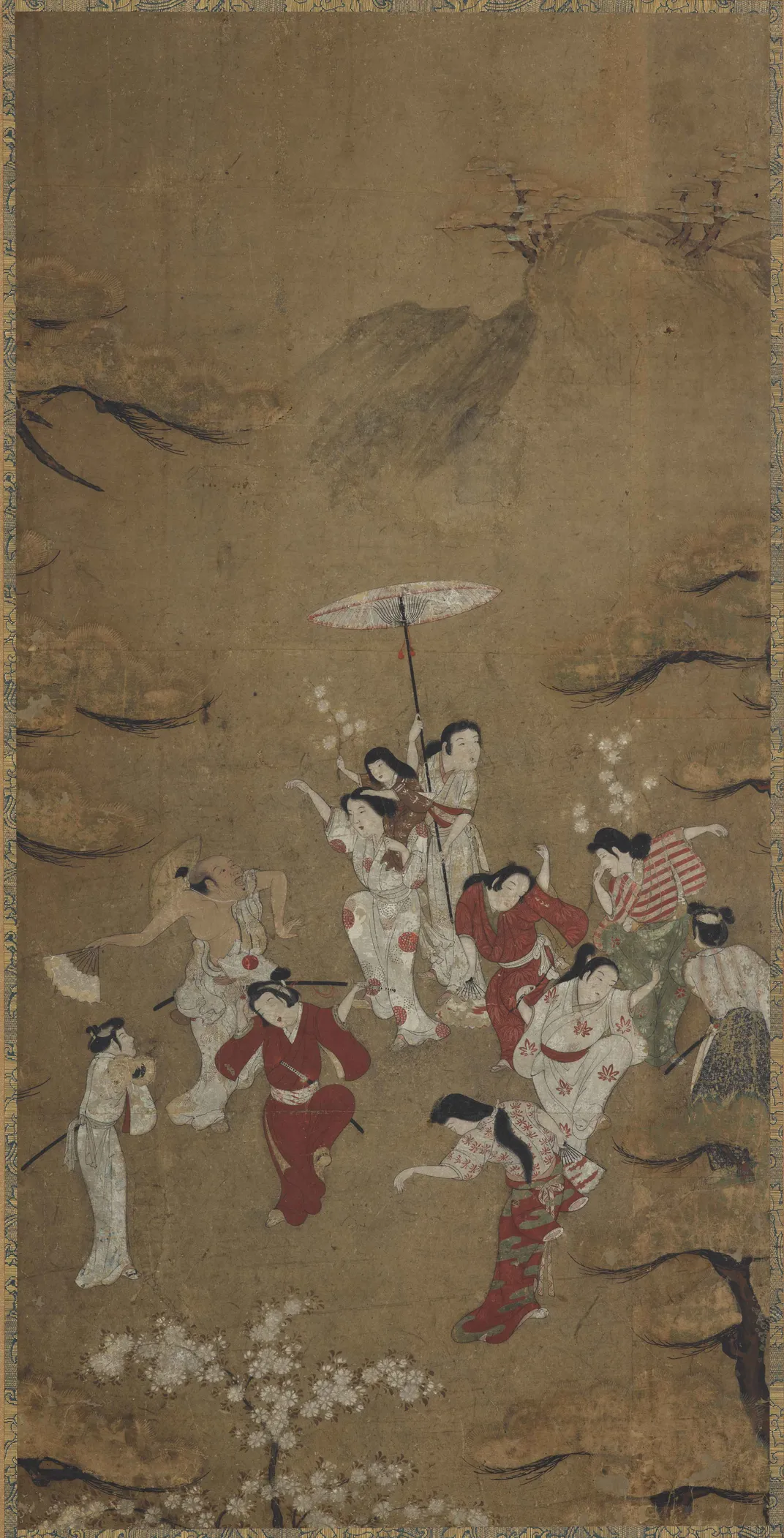
There'south no lounging in this springtime picnic, where all of its 11 figures seem to be expressively dancing to an unseen music source. Fans and parasols are amid the accessories they moving ridge as they dance, only also sprigs of sakura, or crimson blossoms, from the trees around them. The undulating shapes echo the contours of the boughs surrounding their celebrations in this hanging newspaper scroll of the Edo menses. And it would likely enliven any indoor gathering. "Depending on the social occasion, you're trying to create an environment for your guests, that you're having in the room, whatsoever artwork you're displaying," Brooks says. "You lot're putting it out there in order to create the environment that yous want."
Autumn at Asakusa; Viewing cherry blossoms at Ueno Park
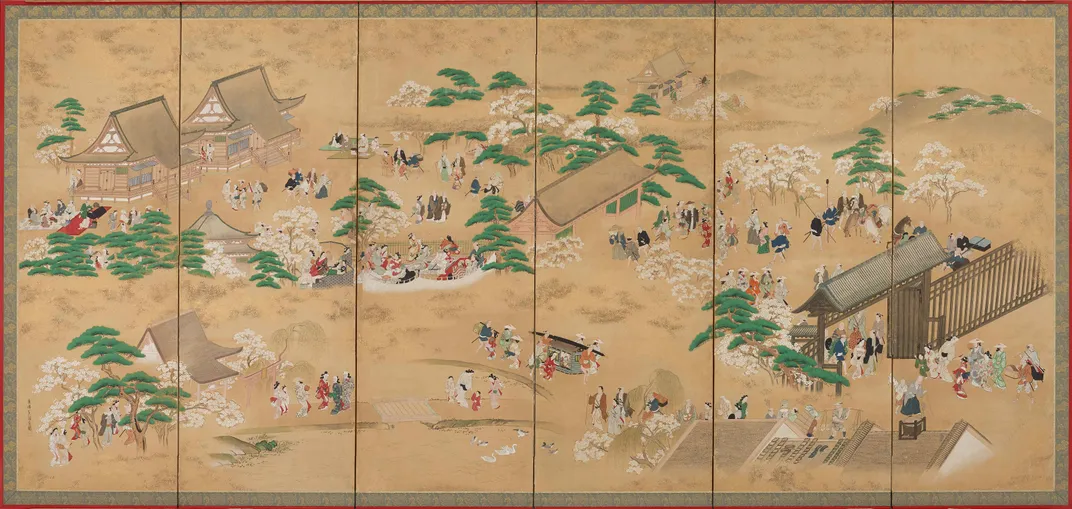
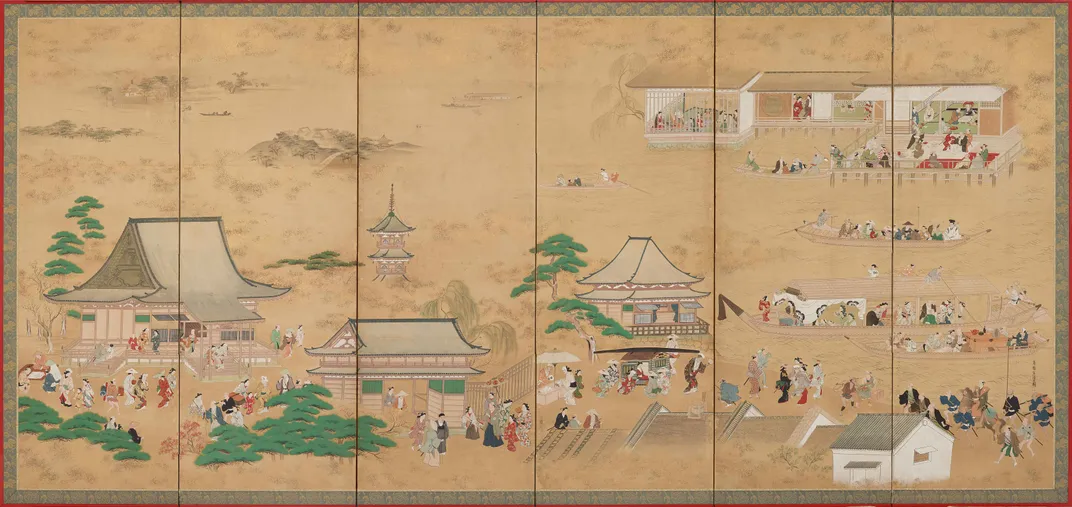
Some other work from Moronobu—25-feet-wide birthday—shows scenes from two dissimilar seasons in Edo, the urban center now known as Tokyo. It's clearly fall on the right-manus screen, where Kannonji Temple, the Sumida River and the Mukojima pleasance houses are on display. On the left, though, crowds come to see ruby-red blossoms in the Ueno area, where the Kaneiji Temple and Shinobazu Pond are depicted. Since the fashions shown can be traced to the end of the 17th century, it'south articulate that they've survived their own national crisis, a March 1657 fire followed past a snowstorm that combined to kill more than 100,000 people.
Owners of such seasonal screens didn't necessarily pull them out to reflect the time of twelvemonth. "In that location is a certain seasonal specificity, but people back in the day weren't necessarily adhering to that very strictly," Feltens says.
Viewing Crimson Blossoms
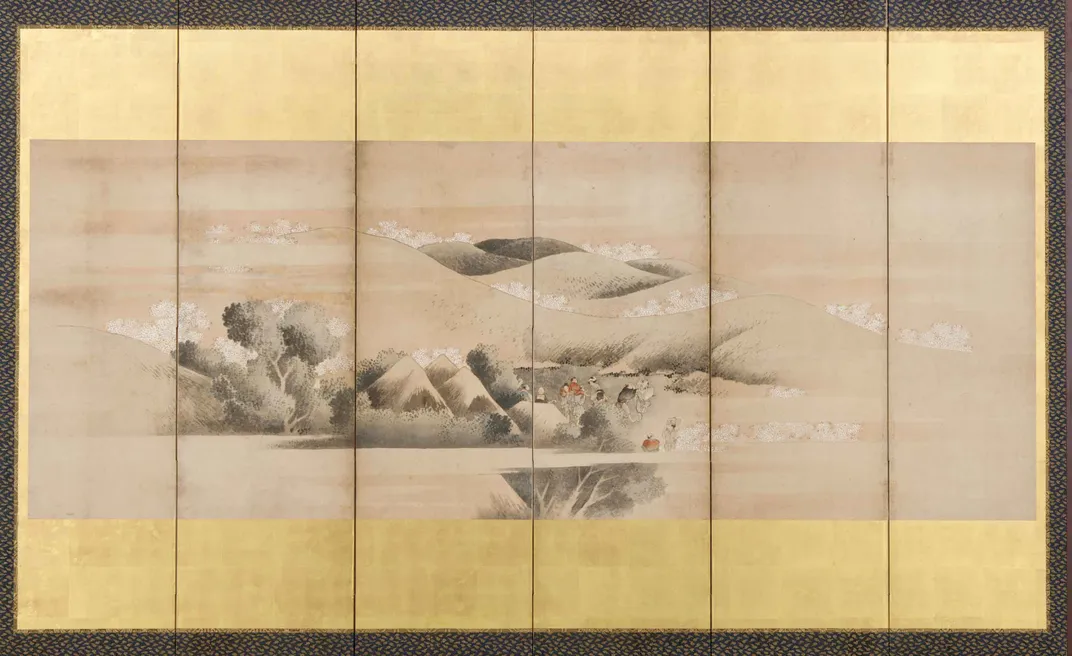
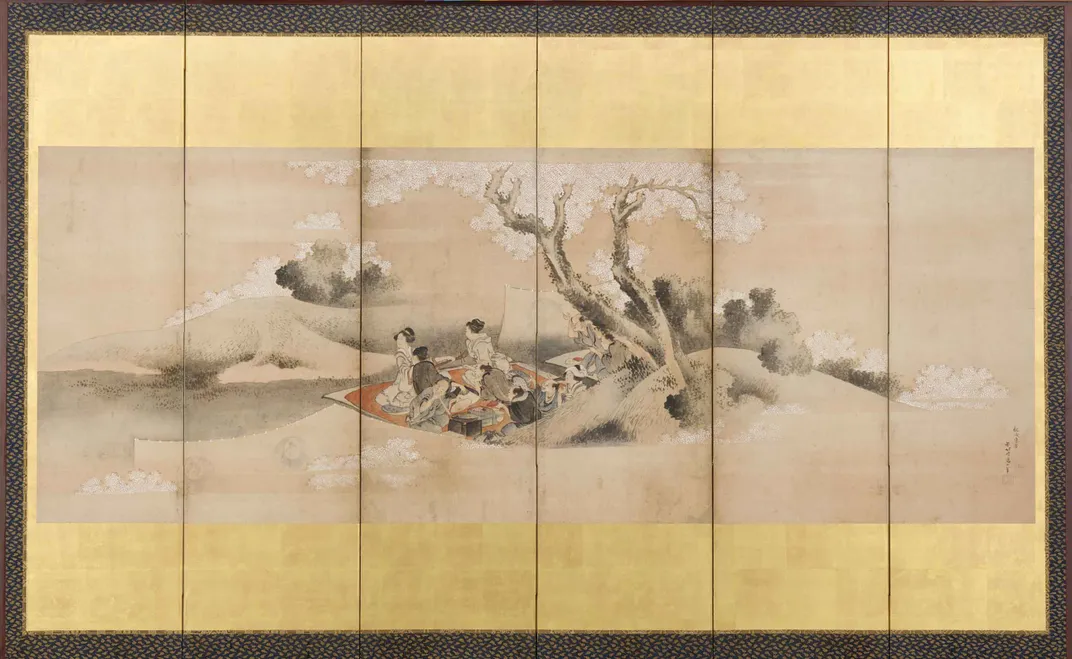
This painting is attributed to the best known Japanese artist Katsushika Hokusai, ukiyo-e painter and printmaker of the Edo period. Hokusai became known for his woodblock print series Thirty-six Views of Mount Fuji and his iconic The Great Wave off Kanagawa. The artist is besides the subject of a current exhibition at the Freer, "Hokusai: Mad About Painting," which is also just available currently online.
"The right (2d slide, above) part of it depicts this grand picnic of these ladies and gentlemen listening to music and drinking sake in a refined way," Feltens says, "And then they all look toward the left and in the left screen you'll meet in the altitude this raucous gathering that is the other form of cherry flower season, where everybody is already very much inebriated and is so happy that they interruption out in spontaneous dancing. I love this screen because it shows these very different styles of enjoying the blossoms in spring."
Also, he promises, "It will exist the first thing that visitors see when the museum reopens." To protect the works on newspaper, the Hokusai exhibition was always meant to take two rotations; this one was always planned for the 2d. "Then this will exist on view once we get back to a semblance of normalcy."
Smithsonian's National Museum of Asian Art is offering a number of online programs and activities, including a curator-led virtual tour of the " Hokusai: Mad Well-nigh Painting " exhibition, an interactive docent bout exploring ruby-red blossoms in the collections and offer cherry blossom art for Zoom backgrounds. Other programs are: "Fine art & Me Preservation Family unit Workshop: Celebrating Ruddy Blossoms" March 27 at 10 a.m.; "Look & Heed: Nature in Japanese Fine art and Music, Kurahashi Yodo 2, shakuhachi," with curator Frank Feltens, April 8 at 7 p.one thousand.; "Teacher Virtual Workshop: Ho-hum Looking and Hokusai," April 10, 11 a.one thousand.; "Jasper Quartet: Music for the Cherry Blossom Festival," April x, seven:30 p.m.; and "Meditation and Mindfulness" with a focus on objects from the museum's Japanese collections, Apr 2 and April 9, noon.
To view the blossoms on the Tidal Basin, bank check out the BloomCam and the Art in Bloom program offers numerous activities and ideas for celebrating the Cherry Blossoms at other locations around the city, or in your own communities.
Source: https://www.smithsonianmag.com/smithsonian-institution/honor-tradition-viewing-cherry-blossoms-signature-japanese-works-art-180977330/
0 Response to "Black and White Art Piece With Torso With No Head by Japanese Artist"
Post a Comment